Many experienced clients approach us seeking clearer guidance on whether a honeycomb catalyst can be tailored to their emission-control systems. In our daily engineering work, we often encounter projects where the exhaust layout, temperature profile, or regulatory target requires a solution more specific than a standard configuration. When we examine requests involving a ceramic catalytic converter, we review the customer’s flow pattern, allowable pressure drop, and integration space to determine whether customization is necessary. During this evaluation process, our team incorporates the capabilities we maintain at Hualian Catalyst to align substrate geometry and coating functions with real operating needs. For units working as an auto exhaust catalyst, we pay attention to fuel characteristics, expected duty cycles, and the compatibility of the catalyst with downstream equipment, ensuring that each requirement is addressed through a practical engineering approach.
Engineering Approach to Customized Honeycomb Structures
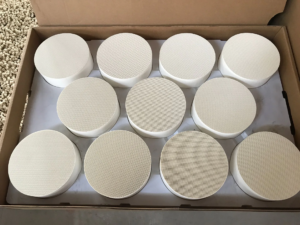
Customization becomes meaningful when it enhances performance reliability rather than simply altering dimensions. Our engineering process begins with substrate selection, coating formulation, and durability assessment under thermal cycling conditions. Projects that require HC, CO, and NOx processing may incorporate HC CO NOx TWC Three Way Catalysts for Automobile Emission Control Ceramic Substrate, allowing different reactions to occur efficiently in a compact design. When a system includes a ceramic catalytic converter, we evaluate substrate porosity, wall thickness, and material stability to maintain consistent catalytic activity. Working with an auto exhaust catalyst also requires well-designed coating distribution, since exhaust gases must contact the catalytic surface uniformly for dependable conversion. Our Honeycomb Ceramic DOC Catalyst follows this principle by supporting oxidation of CO, HC, and SOF while maintaining low pressure drop and high thermal stability. This design serves non-road machinery, construction equipment, and heavy-duty diesel vehicles aligned with Euro III–VI and EPA performance expectations. Each of these characteristics can be modified according to project needs.
Available Custom Options for Honeycomb Catalyst Projects
Our customization services extend across size configuration, cell density selection, coating thickness, and catalyst loading levels. When developing solutions that incorporate a ceramic catalytic converter, we often modify structural features to support stable coating adhesion and reliable thermal expansion behavior. Projects containing an auto exhaust catalyst may require adjusted cell densities to manage gas-speed variations or noise-reduction considerations within the exhaust pathway. The Honeycomb Ceramic DOC Catalyst demonstrates how adaptable designs help customers address different regulatory and operational expectations. Through collaboration on geometry, material choice, and catalytic formulation, we provide options that match the emission characteristics of the customer’s engine while supporting long-term durability.
Conclusion:Customized Honeycomb Catalyst Enhances System Performance
Our experience at Hualian Catalyst shows that a honeycomb catalyst can indeed be customized when engineering and application factors call for tailored configurations. By aligning the ceramic catalytic converter and auto exhaust catalyst with defined emission standards, operating conditions, and integration constraints, we help customers achieve stable conversion efficiency and predictable system behavior. Customization serves as a practical tool to match substrate design with real-world emission-control requirements, ensuring that each solution supports professional, application-specific goals.