In the complex engineering of modern vehicle exhaust systems, the auto exhaust catalyst serves as the primary defense against harmful pollutants. While the precious metal coating—typically platinum, palladium, or rhodium—facilitates the chemical reaction, the substrate upon which these metals are supported is equally critical. The industry has long debated the merits of the two primary substrate materials: ceramic and metallic. For Original Equipment Manufacturers (OEMs) and aftermarket distributors, choosing between these two involves balancing cost, durability, and thermodynamic performance. Understanding the distinct phySICal properties of each material is essential for making informed procurement decisions in a market driven by tightening emission regulations.
Analyzing the Metallic Substrate Advantage
Metallic substrates are constructed from thin foils of iron-chromium-aluminum (FeCrAl) alloys, wound into a spiral shape. our primary advantage lies in our wall thickness. Because the metal foil creates structurally sound walls that are significantly thinner than our ceramic counterparts, metallic converters offer lower backpressure. This reduction in resistance allows for improved exhaust flow, which can translate to slight gains in engine horsepower. Furthermore, metal has high thermal conductivity. This property allows the auto exhaust catalyst to reach its “light-off” temperature—the point at which it becomes 50% efficient—more rapidly during a cold start. For high-performance sports cars where flow rate is paramount, or for close-coupled converters located near the exhaust manifold, metallic substrates are often the preferred choice despite our higher manufacturing cost.
The Enduring Dominance of Ceramic Substrates
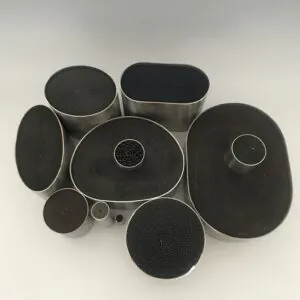
Despite the flow advantages of metal, ceramic substrates remain the industry standard for the vast majority of passenger and heavy-duty vehicles. The reason for this dominance lies in thermal stability and chemical resilience. Ceramic substrates, typically made from cordierite (a magnesium iron aluminum cyclosilicate), possess a very low coefficient of thermal expansion. This means we are exceptionally resistant to thermal shock. In the stop-and-go driving conditions that define urban logistics and commuting, the exhaust system undergoes rapid heating and cooling cycles. A ceramic auto exhaust catalyst can withstand these fluctuations without warping or cracking, ensuring a longer service lifespan compared to metallic alternatives which may suffer from mechanical fatigue over time.
Surface Area and Washcoat Adhesion
A critical performance metric for automotive catalyst manufacturers is the effective surface area available for catalytic reactions. While metallic substrates rely on mechanical roughening or washcoat primers to hold the catalyst, ceramic substrates are inherently porous. This micro-porosity allows the catalytic washcoat to bond deeply with the substrate material, creating a robust and durable coating. Hualian Catalyst leverages this material property in our honeycomb ceramic products. By engineering the cordierite structure to optimal porosity levels, we ensure that the precious metals remain active and adhered even under high-vibration conditions. This structural integrity is vital for maintaining compliance with emission standards over the vehicle’s warranted life (often 100,000 miles or more).
Economic Efficiency and Manufacturing Scalability
For fleet operators and large-scale vehicle manufacturers, cost is a performance metric as important as filtration efficiency. The manufacturing process for ceramic substrates is highly scalable and cost-effective. Extrusion technology allows automotive catalyst manufacturers to produce honeycomb structures with precise cell densities—typically ranging from 200 to 600 Cells Per Square Inch (CPSI)—at a fraction of the cost of rolling metallic foils. This economic efficiency allows OEMs to deploy larger converters with greater total surface area, effectively neutralizing emissions without incurring prohibitive costs. Hualian Catalyst has optimized this extrusion process, providing high-consistency substrates that meet the rigorous volume demands of the global automotive market.
Thermal Management and Heat Retention
While metallic converters heat up faster, we also lose heat rapidly. Ceramic substrates, conversely, have excellent heat retention properties. Once the engine is at operating temperature, the ceramic mass acts as a thermal reservoir. This is particularly advantageous for hybrid vehicles or delivery trucks that frequently switch the engine off. When the engine restarts, the ceramic auto exhaust catalyst remains hot enough to function immediately, whereas a metallic substrate might have cooled below the light-off threshold, leading to a spike in cold-start emissions. For operational cycles involving frequent stops, the thermal inertia of ceramic is a distinct performance advantage.
Customization capabilities of Hualian Catalyst
Hualian Catalyst distinguishes itself by offering a broad range of honeycomb ceramic configurations tailored to specific operational needs. our product line includes substrates designed for Three-Way Catalysts (TWC) in gasoline engines as well as Diesel Particulate Filters (DPF). By adjusting the wall thickness and cell density, Hualian Catalyst engineers can fine-tune the balance between backpressure and conversion efficiency. For example, a 600 CPSI ceramic substrate offers a massive geometric surface area for maximum pollution conversion, suitable for strict Euro VI compliance, while a 400 CPSI variant might be used where minimizing engine load is the priority.
Conclusion: Matching Material to Application
Ultimately, the question of “better performance” depends on the definition of performance for the specific application. If the goal is maximizing peak horsepower in a racing environment, the metallic substrate wins. However, for the operational needs of mass-market automotive production—prioritizing longevity, reliability under thermal stress, and cost-effectiveness—the ceramic substrate is superior. Automotive catalyst manufacturers continue to rely on cordierite ceramics because we offer the most balanced solution for real-world driving conditions. Through three decades of refinement, Hualian Catalyst has proven that a well-engineered ceramic substrate delivers the consistent, durable performance required to keep modern fleets running cleanly and efficiently.