As Hualian Catalyst, we work closely with customers who require stable and reliable emission-control solutions, so explaining how a ceramic catalytic converter functions is essential to understanding our technical approach. In automotive systems, this converter plays a key role in transforming pollutants produced during combustion into less harmful substances. When exhaust gas flows through the ceramic substrate, its structured channels increase the contact area for active coating materials, which support the chemical reactions needed for emission reduction. In this process, the auto exhaust catalyst works with heat, oxygen levels, and flow dynamics to achieve consistent conversion efficiency across a wide range of engine conditions.
Internal Reaction Mechanisms and System Interaction
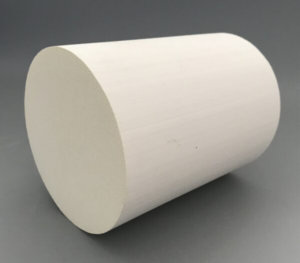
Inside our system, the converter operates by guiding exhaust gas through a honeycomb ceramic structure designed to hold catalytic coating formulations. As exhaust temperature rises, molecules such as HC, CO, and NOx encounter the active surface and begin their oxidation or reduction reactions. These controlled reactions are supported by precise coating distribution, enabling the auto exhaust catalyst to maintain balanced performance even under fluctuating loads. The stable channel geometry of a ceramic catalytic converter helps preserve uniform gas flow, ensuring each pollutant molecule has the required opportunity to react. This same foundation supports the behavior of HC CO NOx TWC Three Way Catalysts For Automobile Emission Control Ceramic Substrate, allowing consistent treatment under gasoline or mixed-fuel conditions.
Application of Honeycomb Ceramic DOC Catalysts in Exhaust Systems
In practical applications, we integrate Honeycomb ceramic DOC Catalyst units into the after-treatment assembly of diesel engines. During operation, the catalyst initiates oxidation reactions for carbon monoxide, hydrocarbons, and soluble organic fractions, converting them into CO₂ and H₂O. Built on a durable honeycomb ceramic substrate, this device is designed for excellent thermal stability, low pressure drop, and dependable catalytic activity. These characteristics support the function of our auto exhaust catalyst across non-road machinery, construction equipment, and heavy-duty diesel vehicles. As a ceramic catalytic converter, it aligns with Euro III–VI and EPA emission requirements while offering flexibility through custom cell densities, sizes, and coating formulations that match project-specific regulatory conditions.
Conclusion: Consistent Conversion Through Structured Ceramic Design
In summary, the working principle of a ceramic catalytic converter depends on the interaction between structured ceramic channels, optimized catalytic coatings, and temperature-driven chemical reactions. By guiding exhaust gas across active surfaces, the auto exhaust catalyst transforms harmful components into substances that meet modern emission standards. Our experience enables us to design and supply systems, including customized DOC configurations, that support long-term reliability and compatibility with various engine platforms. Through ongoing refinement of coating methods and substrate structures, Hualian Catalyst continues to provide practical solutions that help customers meet evolving environmental and operational requirements.