We focus on developing exhaust-aftertreatment systems that maintain steady performance across different operating conditions. In the middle of our workflow, Hualian Catalyst integrates material engineering and emission-control design to support consistent catalytic reactions. The function of a motorcycle catalyst or a larger vehicle system relies on stable contact between exhaust gases and the coated metal surface. When we work with a metallic catalytic converter, we ensure that the substrate geometry encourages uniform gas flow, helping the catalyst remain active throughout typical driving cycles. The overall process supports customers who operate motorcycles, gasoline vehicles, and diesel platforms that must meet regulated emission limits.
Heat Transfer and Reaction Mechanism
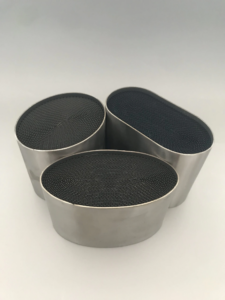
Metal substrates play a direct role in determining how a system processes pollutants. The working principle behind a metallic catalytic converter depends on the fast heat-transfer capability of its thin-walled honeycomb structure. When the engine starts, exhaust passes through the channels and warms the coated metal surface quickly, allowing oxidation and reduction reactions to begin within a short period. This rapid activation matters especially for motorcycle catalyst programs, where small engines frequently change load and temperature. During operation, heat distribution and substrate stability help maintain reaction efficiency while preventing deformation. Our Metallic Catalytic Converter Euro 3/4/5/6 standard supports these conditions by providing a reliable structure for sustained catalytic activity, ensuring that vehicles meet the expected emission-control requirements.
Application Scenarios and System Integration
We collaborate with clients who manage fleets or equipment that operate under varying temperature cycles and vibration levels. In these environments, a metallic catalytic converter must combine durability with low exhaust resistance. The honeycomb metal substrate, widely used in motorcycles and vehicle platforms, maintains gas flow while reducing back pressure, protecting engine responsiveness. The same principles apply to motorcycle catalyst installations, where compact designs require predictable thermal behavior and long-term reliability. Our systems are suitable for Euro 3–6 and Tier IV applications involving diesel trucks, power generators, off-road machinery, and passenger vehicles. To support integration into different layouts, we offer customized dimensions, cell densities, and coating formulations that address performance, durability, and installation constraints.
Conclusion
The way a metal catalytic converter works is defined by heat-transfer efficiency, stable reactions, and substrate durability. A metallic catalytic converter provides a controlled environment for reducing hydrocarbons, carbon monoxide, and nitrogen oxides, and the same principles also guide our motorcycle catalyst solutions. Through careful material selection and structural design, we create systems that help customers maintain long-term compliance and reliable operation. Our continued development efforts focus on supporting real-world requirements through practical engineering and predictable performance.