Understanding how much a catalytic converter costs for a company requires looking at the technical and operational needs behind each application. When companies seek solutions from a catalytic converter supplier, the cost is shaped by the converter structure, substrate material, coating formulation, and required emission level. In many industrial and vehicle programs, companies compare metallic options with a ceramic catalytic converter to determine which configuration meets their long-term performance expectations. Within this evaluation process, Hualian Catalyst plays a role by supporting clients with accurate matching between engine conditions and converter capability, ensuring that cost considerations reflect real operational requirements.
Technical Performance and Its Impact on Budget
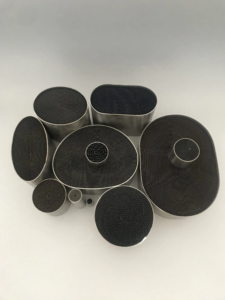
Companies focusing on budget planning often review how thermal performance, durability, and emission compliance affect pricing. A catalytic converter supplier provides multiple substrate choices, each influencing heat-up characteristics, back-pressure levels, and reliability under vibration or frequent cold starts. Selecting a ceramic catalytic converter or a metallic solution depends on the engine duty cycle and desired emission stability. In many projects, our metallic catalytic converter designed for Euro 3/4/5/6 standards is installed in the exhaust aftertreatment system to support catalytic reactions that reduce key pollutants. The honeycomb metal substrate helps the catalyst activate quickly due to fast heat transfer, while the thin-wall structure maintains low back pressure, an important factor for companies calculating operational efficiency. These performance characteristics directly influence the total investment companies expect to allocate.
Customization Requirements and Company Planning
Budget decisions also depend on how much customization a company needs. Many equipment manufacturers, truck builders, and generator system integrators request specific dimensions, coating loads, or cell densities to match power output and durability requirements. Working with Hualian Catalyst enables companies to evaluate customization depth and the resulting impact on cost. Whether a project involves a ceramic catalytic converter or a metallic unit, meeting Euro 3–6 or Tier IV standards often requires adjustments to geometry and coating formulations. Collaborating with a catalytic converter supplier also includes discussions on testing procedures, expected service intervals, and installation constraints. For this reason, determining how much a catalytic converter costs for a company becomes a combination of engineering design, compliance targets, and long-term operational planning rather than a single price point.
Conclusion
Estimating how much a catalytic converter costs for a company depends on performance expectations, customization needs, and emission requirements. Companies comparing a ceramic catalytic converter with a metallic unit should consider back-pressure characteristics, heat-up behavior, and system durability to establish an accurate budget. Working with a catalytic converter supplier provides the technical insight needed to match converter design with real operating conditions. Through this process, Hualian Catalyst supports clients in selecting configurations that balance cost, reliability, and compliance, creating a practical framework for long-term planning and efficient system operation.