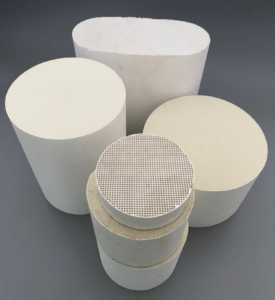
As a manufacturer working closely with advanced emission-control systems, Hualian Catalyst places great emphasis on the proper handling and maintenance of diesel after-treatment components. When discussing auto exhaust catalyst maintenance, cleaning is often a key topic raised by experienced users in heavy-duty diesel applications. A ceramic honeycomb catalyst operates within high-temperature and chemically complex environments, and understanding its structure helps determine whether cleaning is appropriate. Our honeycomb ceramic DOC Catalyst-Honeycomb Ceramic Structure is widely used in diesel systems because the substrate is stable, mechanically durable, and able to host oxidation reactions efficiently. Before proceeding with any cleaning steps, we always recommend confirming that the catalyst surface contamination comes from soot or oil residues rather than irreversible thermal or chemical damage.
When Cleaning a Ceramic Honeycomb Catalyst Is Appropriate
For operators who rely on ceramic catalytic converter devices, blockage from soot, unburned hydrocarbons, or lubricating oil mist can reduce catalytic efficiency and increase backpressure. In such cases, a controlled cleaning approach may help restore airflow uniformity. We typically advise beginning with an external inspection and compressed-air cleaning performed in a direction opposite to normal exhaust flow. This method is suitable for non-bonded particulate accumulation and avoids direct surface abrasion. If the DOC Catalyst-Honeycomb Ceramic Structure has encountered heavier deposits, such as oil-derived ash, a low-temperature baking procedure may be applied by experienced technicians. This step loosens surface residues without compromising the substrate’s thermal stability. Throughout the cleaning process, operators should monitor cell integrity to ensure no cracking or deformation occurs, since physical damage cannot be resolved through cleaning alone.
Precautions and Best Practices During the Cleaning Process
Our experience with auto exhaust catalyst systems for non-road machinery, heavy-duty diesel vehicles, and construction equipment shows that improper cleaning is a common cause of performance decline. Water-based cleaning or aggressive chemical flushing may seem effective in the short term but can severely affect the coating layer, reducing catalytic activity. To maintain the durability of the DOC Catalyst-Honeycomb Ceramic Structure, we always prioritize dry-method cleaning or controlled thermal regeneration. Another important step is verifying system conditions after cleaning. Ensuring proper fuel quality, stable engine calibration, and absence of lubricant overconsumption prevents repeated contamination. Since our products support customized sizes, cell densities, and coating formulations, end-users often consult us to confirm the correct cleaning approach that matches their specific configuration.
Conclusion: Ensuring Long-Term Efficiency Through Proper Care
Maintaining a ceramic catalytic converter through appropriate cleaning helps preserve exhaust flow and supports stable emission-control performance. While cleaning can remove certain surface deposits, it cannot recover losses caused by coating degradation or thermal overload. As manufacturers, we encourage users to combine preventative maintenance, proper operating conditions, and periodic inspections to maximize the service life of our DOC Catalyst-Honeycomb Ceramic Structure. With correct practices, we ensure our system continues to convert harmful exhaust components into less harmful substances, supporting reliable operation across diverse diesel applications.