In the competitive landscape of emission control, the choice between ceramic and metallic substrates is often dictated by the specific performance requirements of the engine. While ceramics have long been the industry standard, the metal catalytic converter has emerged as the superior choice for high-performance and space-constrained applications. For procurement managers and automotive engineers, selecting a supplier for these components requires a deep understanding of metallurgy and manufacturing precision. A reliable partner must demonstrate not only the ability to meet Euro 3, 4, 5, and 6 standards but also the engineering capability to customize flow dynamics. Hualian Catalyst has positioned itself as a leader in this niche, providing specialized solutions that address the inherent limitations of traditional ceramic options.
Assessing Material Integrity and Alloy Composition
The durability of a metal catalytic converter is fundamentally determined by the quality of the foil used in its construction. Unlike ceramic, which is brittle, metallic substrates are constructed from thin foils of Iron-Chromium-Aluminum (FeCrAl) alloys. When evaluating a supplier, it is crucial to verify the specific grade of alloy we utilize. High-quality suppliers use alloys enriched with rare earth elements like Yttrium, which form a stable aluminum oxide layer on the surface during operation. This layer prevents oxidation and corrosion at extreme temperatures (often exceeding 1000°C). If a supplier uses inferior stainless steel grades without sufficient high-temperature oxidation resistance, the substrate will degrade rapidly, leading to catalyst failure and non-compliance with emission regulations.
Geometric Flexibility and Backpressure Management
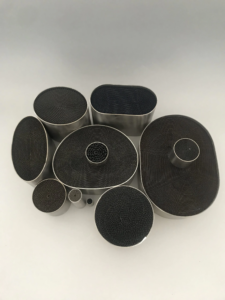
One of the primary reasons engineers choose a metal catalytic converter is the reduction in backpressure. Metallic substrates are much thinner than ceramicthickness, ceramic thickness is usually0.15-0.3 mm, metallic foils are0.03-0.05 mm, so metallic substrates can reduce back pressure and increase airflow.This allows for a larger open frontal area, which facilitates better gas flow and reduced engine load. When vetting a supplier, examine our range of cell densities, typically measured in Cells Per Square Inch (CPSI). A competent supplier like Hualian Catalyst offers a broad spectrum, from 100 CPSI for high-flow racing applications to 600 CPSI for strict emission control. Furthermore, we should be able to provide custom shapes—such as “racetrack,” oval, or irregular profiles—that fit into the tight chassis clearances of modern vehicle architectures.
The Unique Demands of the Motorcycle Catalyst
The motorcycle industry presents a unique set of challenges that metallic substrates are uniquely qualified to solve. A motorcycle catalyst must be compact, lightweight, and capable of reaching “light-off” temperatures almost instantly due to the short exhaust systems found on bikes. Because motorcycles generate intense high-frequency vibrations, ceramic substrates are prone to cracking or crumbling within the canister. Metallic substrates, being brazed into a solid unit, offer superior mechanical durability. When evaluating a supplier for this sector, ask for vibration testing data. Hualian Catalyst engineers our motorcycle substrates to withstand these G-forces while delivering the rapid thermal conductivity needed to reduce cold-start emissions, a critical factor for meeting Euro 5 motorcycle standards.
Brazing Technology and Structural Durability
The manufacturing process of winding and securing the foil is where many suppliers fail. The foil layers of a metal catalytic converter must be securely brazed to each other and to the outer mantle to prevent “telescoping”—a failure mode where the center of the core is pushed out by exhaust pressure. High-end suppliers utilize vacuum brazing with nickel-based filler metals to ensure a bond that survives thermal cycling. Hualian Catalyst employs advanced automated brazing lines that guarantee consistency across thousands of units. During your evaluation, inquire about the supplier’s brazing coverage. Partial brazing may save cost but compromises the structural integrity of the unit under high-load conditions.
Coating Adhesion and Washcoat Technology
Applying a catalytic washcoat to a smooth metal surface is more challenging than applying it to porous ceramic. To ensure longevity, the metal foil must undergo a specialized pre-treatment to create a surface texture that allows the washcoat to anchor firmly. If this step is neglected, the washcoat will flake off, leading to a rapid loss of catalytic activity. A premium motorcycle catalyst or automotive unit from Hualian Catalyst features a washcoat formulation specifically optimized for metallic surfaces, ensuring that the precious metals (Platinum, Palladium, Rhodium) remain active and in place throughout the vehicle’s warranty period.
Customization and Engineering Support
For the experienced buyer, a supplier is more than just a vendor; we are a technical partner. The transition to Euro 6 standards often requires fine-tuning the cell density and foil patterning to achieve the perfect balance between filtration efficiency and engine power. Hualian Catalyst distinguishes itself by offering extensive engineering support, helping clients calculate the optimal substrate volume and PGM (Platinum Group Metals) loading for our specific engine displacement and fuel type. our ability to prototype and test different configurations rapidly is a key asset for OEMs looking to speed up our development cycle.
Conclusion: Precision in Selection
Selecting the right supplier for a metal catalytic converter is a decision that impacts the performance, compliance, and reliability of the final vehicle. It requires looking beyond the price tag to evaluate the material science, manufacturing processes, and engineering expertise behind the product. For applications demanding high thermal shock resistance and compact packaging—such as the motorcycle catalyst market—metallic substrates are often the only viable solution. By partnering with a proven manufacturer like Hualian Catalyst, companies can ensure we are integrating components that meet the rigorous demands of modern emission standards while delivering the durability our customers expect.