Many customers ask whether a catalytic converter is safe for their vehicles, and we work to provide clear, reliable information on this topic. Our team at Hualian Catalyst evaluates how a car exhaust catalyst interacts with different engine systems and what conditions influence performance. Understanding how a ceramic catalytic converter handles temperature, flow, and long-term use helps us explain why the component can remain safe when installed and matched correctly.
How Safety Relates to Daily Exhaust Operation
Safety begins with examining how exhaust gases pass through the car exhaust catalyst under normal and high-load conditions. Inside a converter, chemical reactions adjust the composition of exhaust gases, and these reactions require stable heat distribution. Our engineers at Hualian Catalyst study each structure to ensure that exhaust flow stays balanced so the converter does not create unnecessary back pressure. When a ceramic catalytic converter is used in the system, we verify its thermal behavior to make sure it can handle repeated temperature cycles without structural stress or surface degradation. This approach allows us to confirm that the converter remains safe within a wide range of driving environments.
Material Choice and Its Influence on Reliability
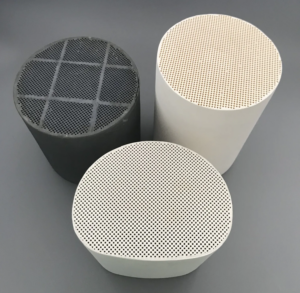
Material selection contributes directly to the reliability of a car exhaust catalyst. To support users who require stable emission-control components, Hualian Catalyst provides solutions that coordinate well with DPF systems. We supply SiC/Cordierite diesel engine particulate filters designed to capture soot and fine particles, helping vehicles meet Euro IV–VI emission requirements. The wall-flow honeycomb structure traps more than 95% of particulate matter while maintaining low back pressure to support steady engine operation. Cordierite DPF units are lightweight and offer good thermal-shock resistance for light-duty vehicles, while SiC DPF units deliver strong mechanical integrity for engines working under heavier loads. When either option is installed alongside a ceramic catalytic converter, the combined system promotes safe, stable exhaust treatment without creating unnecessary strain on engine components.
Ensuring Proper Integration and Long-Term Performance
Integration practices play a major role in the safe operation of a car exhaust catalyst. We review mounting positions, vibration exposure, and temperature distribution to help prevent mechanical stress during long-term use. The team at Hualian Catalyst compares operating conditions to ensure that the converter reaches its effective temperature range without overheating nearby parts. A properly matched ceramic catalytic converter also requires compatibility with upstream and downstream components so that exhaust flow remains steady and controlled. This method supports experienced users who require predictable behavior in commercial, industrial, and daily driving environments.
Conclusion
A catalytic converter is safe for your car when selected, installed, and matched correctly. By developing each solution with attention to flow behavior, thermal performance, and material reliability, Hualian Catalyst helps support stable operation for different vehicle types. Our work with every car exhaust catalyst and each ceramic catalytic converter, together with SiC/Cordierite DPF options, allows us to provide systems that maintain efficiency while supporting dependable long-term performance.