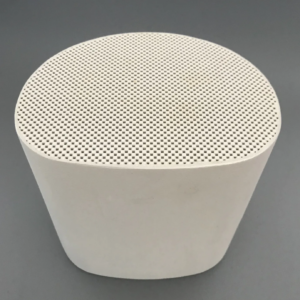
At Hualian Catalyst, we evaluate technical indicators carefully whenever we source or manufacture a SiC DPF solution. For customers seeking reliable aftertreatment performance, the material composition, filtration efficiency, and regeneration behavior are core considerations. A wall flow diesel particulate filter is built with a honeycomb structure that channels exhaust through porous walls, and we rely on this structure to maintain steady flow while removing soot across a broad range of operating conditions. Our team observes how each filter handles thermal cycling, soot loading, and backpressure stability, because these specifications directly influence long-term engine compatibility. The fundamental design—especially the combination of wall-flow geometry and silicon carbide or cordierite substrates—guides how well the filter performs in daily use.
Material Properties and Temperature Resilience
When we evaluate materials, the thermal threshold of the substrate is one of the most important specifications. A SiC DPF offers strong thermal conductivity, which helps the filter disperse heat during passive regeneration, while a wall flow diesel particulate filter made of cordierite provides a balance of durability and cost efficiency. We examine how each substrate behaves during continuous high-temperature exposure because diesel exhaust temperatures fluctuate significantly. Our products incorporate either silicon carbide or cordierite to support reliable filtration and soot oxidation under demanding loads. This high-temperature resilience allows us to ensure that filtration efficiency remains stable even during extended operation. Additionally, the structure supports more than 95% soot capture through efficient wall-flow filtration, enabling clean exhaust passage without compromising pressure stability.
Regeneration Behavior and Customizable Design
Another specification we prioritize is the filter’s ability to support both passive and active regeneration modes. For many of our customers, predictable regeneration helps maintain consistent fuel consumption and prevents unplanned downtime. Passive regeneration occurs naturally when the exhaust temperature is sufficient, while active regeneration provides the extra heat required when driving conditions cannot sustain automatic soot burn-off. When sourcing a SiC DPF, we assess whether the regeneration pattern aligns with different engine types and usage cycles. We also look at dimensional flexibility, because customization is essential in professional applications. Our wall flow diesel particulate filter solutions can be produced in round or square shapes with adjustable diameter, length, and cell density ranging from 100 to 350 CPSI. These options give us the ability to match installation needs while meeting Euro 4, Euro 5, and Euro 6 emission targets effectively.
Conclusion: Specifications That Drive Sourcing Decisions
In conclusion, sourcing a dependable SiC DPF requires examining filtration structure, thermal performance, regeneration behavior, and dimensional flexibility. As we integrate these specifications into our development and sourcing process, we ensure that each wall flow diesel particulate filter supports stable soot capture, high-temperature endurance, and compliance with demanding emission regulations. By focusing on these measurable characteristics, we maintain solutions that align with the expectations of experienced users who rely on durable and precise aftertreatment systems.