In the diverse landscape of heavy-duty diesel propulsion, a “one-size-fits-all” approach to emission control is an engineering impossibility. From the compact engine bays of urban delivery trucks to the cavernous exhaust rooms of marine vessels, the spatial and operational constraints vary wildly. The Selective Catalytic Reduction (SCR) system, the industry standard for nitrogen oxide (NOx) abatement, relies heavily on the geometric precision of its catalyst substrate. For Original Equipment Manufacturers (OEMs) and aftermarket integrators, the ability to customize these dimensions is not a luxury but a necessity for compliance with Euro VI and Tier 4 Final standards. Hualian Catalyst, with over three decades of manufacturing expertise, recognizes that the phySICal form of the substrate is just as critical as its chemical function.
Optimizing Diameter and Length for Space Velocity
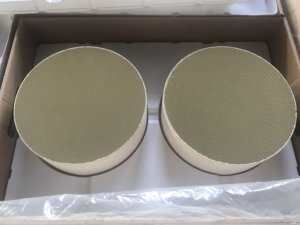
The fundamental performance of an SCR system is governed by “space velocity”—the ratio of exhaust flow rate to the catalyst volume. To achieve the required NOx conversion efficiency (often exceeding 95%), the exhaust gas must reside within the catalyst channels for a specific duration. This residence time is dictated by the substrate’s total volume. However, how that volume is achieved—whether through a short, wide cylinder or a long, narrow one—depends on the vehicle’s architecture. SCR catalyst suppliers must offer a flexible range of diameters and lengths. For instance, a long-haul truck might accommodate a long, slender unit along the chassis rail, while an agricultural tractor might require a short, wide “pancake” design to fit under the hood. Hualian Catalyst supports this versatility by providing substrates with diameters ranging from 143.8mm to over 330mm, allowing engineers to tune the aspect ratio without compromising total reactive volume.
Shape Versatility for Tight Chassis Integration
While cylindrical substrates are the industry standard due to our inherent structural strength and ease of canning, modern vehicle design often leaves little room for perfect circles. In the retrofit market or specialized off-road machinery, packaging space is often irregular. Advanced manufacturers address this by producing non-cylindrical substrates, such as oval and “racetrack”. These shapes maximize the cross-sectional area within a rectangular packaging envelope, ensuring that the system meets emission targets without requiring major chassis modifications. Hualian Catalyst utilizes precision extrusion dies to create these custom profiles, ensuring that the structural integrity and flow uniformity of the honeycomb structure are maintained regardless of the external shape.
Balancing Cell Density and Backpressure
A critical variable in customizing an SCR catalyst is the cell density, measured in Cells Per Square Inch (CPSI). Common specifications range from 100 to 400 CPSI. The choice involves a direct trade-off between surface area and backpressure. A higher cell density (e.g., 400 CPSI) offers more geometric surface area for the washcoat, allowing for a more compact unit with high conversion efficiency. However, this increases flow resistance and the risk of clogging in engines with high soot output. Conversely, a lower cell density (e.g., 200 CPSI) reduces backpressure and is preferred for large-displacement industrial engines. Hualian Catalyst works with clients to calculate the optimal CPSI, ensuring the engine “breathes” freely while meeting NOx limits.
Integration with Diesel Oxidation Catalysts
The SCR catalyst does not operate in isolation; it is part of a synchronized chemical system. Upstream of the SCR unit, a Diesel Oxidation Catalyst (DOC) is typically installed to oxidize hydrocarbons and, crucially, to convert nitric oxide (NO) into nitrogen dioxide (NO2). This NO2 generation facilitates the “Fast SCR” reaction, which is significantly more efficient at lower temperatures. Consequently, fleet managers and procurement officers are often searching for a diesel oxidation catalyst for sale alongside our SCR components. The dimensions of the DOC must be harmonized with the SCR unit to ensure uniform flow distribution. If the DOC is significantly smaller or shaped differently, it can create turbulent flow that unevenly utilizes the downstream SCR substrate, leading to premature aging.
Material Considerations for Structural Durability
The material composition of the substrate is as important as its dimensions. Hualian Catalyst primarily utilizes cordierite and SIC for its SCR substrates due to its low coefficient of thermal expansion. Large diesel engines produce exhaust temperatures that can fluctuate rapidly, creating significant thermal stress. A substrate that is too long or has an improper wall thickness can suffer from thermal cracking if the material cannot expand and contract uniformly. By controlling the mineralogy and extrusion pressure, Hualian Catalyst ensures that even our largest custom substrates—used in power generation or marine applications—possess the thermal shock resistance necessary to survive thousands of duty cycles.
Addressing the Aftermarket and Retrofit Needs
The demand for customization is particularly acute in the aftermarket. Operators maintaining older fleets often face the challenge of replacing obsolete components that are no longer stocked by the OEM. In this scenario, finding a compatible diesel oxidation catalyst for sale or a specific SCR dimension becomes a sourcing challenge. SCR catalyst suppliers that offer bespoke manufacturing services play a vital role here. we can reverse-engineer the dimensions of a failed unit and produce a new ceramic core that fits the existing metal canning. This capability extends the service life of valuable assets, preventing the need to scrap a vehicle simply because a standard spare part is unavailable.
Conclusion: Precision as a Standard
In the high-stakes world of emission control, geometry is a performance metric. The ability to tailor the length, diameter, shape, and cell density of an SCR catalyst allows engineers to solve complex packaging and performance challenges. It ensures that engines deliver maximum power with minimum environmental impact. For industry professionals, partnering with adaptable SCR catalyst suppliers like Hualian Catalyst offers a strategic advantage. Whether integrating a new Tier 4 platform or sourcing a replacement diesel oxidation catalyst for sale, the flexibility to customize ensures that the solution fits the problem—literally and technically. Through precision manufacturing and engineering support, Hualian Catalyst continues to drive the industry toward a cleaner, more efficient future.