How Are Catalytic Converters Manufactured? A Deep Dive into the Process
Have you ever wondered how the catalytic converter—your vehicle’s emission-fighting powerhouse—is crafted? Behind every unit that turns harmful HC, CO, and NOₓ into harmless gases lies a precise, multi-step manufacturing process. For businesses partnering with automotive catalyst manufacturers or a trusted catalytic converter supplier, understanding this journey isn’t just a curiosity—it’s vital for choosing a partner that delivers quality, compliance, and performance. With over 30 years of expertise, Hualian Catalyst has honed its manufacturing process to perfection, blending advanced materials, precision engineering, and strict quality control to produce top-tier catalytic converters for automotive and industrial use. Let’s take a deep dive into how these essential emission-control devices are made.
Substrate Selection – The Foundation of a Reliable Catalytic Converter
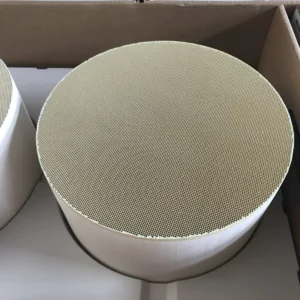
Every catalytic converter starts with a substrate—the structural core that maximizes surface area for pollutant conversion. Leading automotive catalyst manufacturers rely on two primary materials, each tailored to specific use cases:
Honeycomb Ceramic Substrates: The workhorse for most applications, Hualian’s ceramic substrates feature a dense grid structure with 200–300 CPSI (cells per square inch—think of it as the density of tiny channels that maximize contact between exhaust gases and the catalyst). Sourced from high-quality cordierite or SiC (silicon carbide), these substrates boast exceptional thermal stability, critical for withstanding extreme exhaust temperatures. They’re engineered to meet Euro 2–6 standards, ensuring global regulatory compliance.
Metallic Substrates: For motorcycles and high-performance vehicles, Hualian uses SUS 304 stainless steel substrates coated with Pt, Pd, or Rh. These are lighter, more durable, and customizable in shape—perfect for OEM-specific fit requirements, a testament to Hualian’s customer-centric approach.
A poorly designed substrate leads to uneven gas flow and reduced efficiency, so Hualian’s substrate production adheres to strict tolerances, laying the groundwork for reliable performance.
Precision Coating – The Core of Hualian Catalyst’s Expertise
The substrate alone can’t reduce emissions—its surface needs a catalyst “washcoat” that triggers chemical reactions to break down pollutants. This step is where Hualian Catalyst’s R&D prowess shines:
Tailored Formulations: Hualian uses application-specific coatings: Pt/Pd/Rh for universal DOC/POC converters (delivering over 90% conversion efficiency), Fe Zeolite or V₂O₅-TiO₂ for SCR catalysts (targeting diesel NOₓ), and ZnO/nickel for industrial hydrogenation catalysts.
Uniform Application: The washcoat is applied via precision dipping, ensuring every cell gets consistent coverage. Hualian’s custom coating service lets clients adjust thickness and composition—essential for businesses with unique engine or equipment needs.
Strict quality control is non-negotiable here: even minor coating inconsistencies can slash efficiency by 10–15%. Hualian’s labs test every batch for adhesion and catalytic activity, backed by ISO 9001 and IATF 16949 certifications (the updated standard for automotive quality management, aligning with industry practices).
High-Temperature Sintering – For Long-Lasting Durability
After coating, the substrate undergoes sintering—heating to 1,000–1,200°C in computer-controlled ovens. This process bonds the washcoat to the substrate, creating a robust structure that endures exhaust temperatures exceeding 800°C.
Hualian optimizes sintering for consistency: uniform heat distribution prevents warping or cracking. For SiC-based DPFs (used in heavy-duty diesel trucks), sintering also enhances porosity—improving particulate trapping without restricting airflow. This attention to detail makes Hualian a trusted catalytic converter supplier for commercial vehicle manufacturers worldwide.
Assembly & Customization – Meeting Client-Specific Needs
Post-sintering, the catalyst core is assembled into a stainless steel housing with leak-proof gaskets and clamps. Hualian’s assembly line embraces OEM flexibility:
Size & Shape: From compact motorcycle catalysts to industrial catalytic applications, production aligns with client drawings.
System Integration: Diesel solutions pair DPFs with SCR/DOC/POC units, plus custom DPF/DAF stainless steel clamps for easy installation.
Packaging & Lead Time: Standard export crates protect products during shipping, with 15–20 working days for custom orders—critical for businesses managing tight production timelines.
Quality Control – Ensuring 100% Compliance & Performance
No unit leaves Hualian’s factory without rigorous testing:
Emission Efficiency: Dynamometer tests confirm over 90% pollutant conversion, meeting Euro 3–6 standards.
Durability Checks: Thermal shock and vibration tests simulate years of use, guaranteeing longevity.
Documentation: Every order includes a detailed testing report, simplifying regulatory compliance for clients.
This commitment to quality has earned Hualian partnerships with 5,000+ global companies and support for 278,000+ projects.
Choose Hualian Catalyst: Where Precision Meets Partnership
From substrate selection to final delivery, manufacturing a top-tier catalytic converter demands expertise, precision, and customer focus—all hallmarks of Hualian Catalyst. As a leading catalytic converter supplier and automotive catalyst manufacturer, Hualian combines 30+ years of industry experience, globally recognized certifications, and 24/7 technical support to deliver tailored solutions. Whether you’re an automotive OEM needing Euro 6-compliant converters or an industrial operator seeking specialized catalysts, Hualian doesn’t just sell products—we provide reliable, sustainable emission-control systems that drive business success. The next time you rely on a catalytic converter to meet regulations, remember: it’s the result of careful engineering—something Hualian has mastered to become a trusted partner for businesses worldwide.