What Is SCR Catalyst and How Does It Work? Insights from Trusted SCR Catalyst Suppliers
For fleet managers, industrial equipment operators, and diesel OEMs relying on diesel engines, meeting Euro 6/China VI emission standards boils down to mastering two synergistic technologies: SCR catalyst (Selective Catalytic Reduction) and diesel oxidation catalysts (DOC). While diesel oxidation catalysts tackle carbon monoxide (CO) and hydrocarbons (HC), SCR catalysts are the unsung heroes of nitrogen oxide (NOₓ) reduction—without them, achieving near-zero NOₓ emissions (a core regulatory requirement) is nearly impossible. As one of the most trusted scr catalyst suppliers and DOC manufacturers, Hualian Catalyst draws on 30+ years of emission control expertise to demystify SCR catalysts: what they are, how they work (often hand-in-hand with diesel oxidation catalysts), and why partnering with the right supplier is critical for 2B clients.
What Is SCR Catalyst? Definition & Core Role in Emission Control
An SCR catalyst is a specialized emission control component designed to convert harmful NOₓ (a toxic, smog-forming pollutant from diesel engines) into harmless nitrogen (N₂) and water (H₂O) through a targeted chemical reaction. Unlike diesel oxidation catalysts— which oxidize pollutants directly using exhaust oxygen—SCR catalysts rely on a dedicated reducing agent: urea-based AdBlue (DEF, Diesel Exhaust Fluid). This “selective” reaction ensures only NOₓ is converted, leaving other exhaust components untouched.
Hualian’s SCR catalysts are engineered for diesel engines spanning 10–2000 kW (from light-duty trucks to industrial generators) and come in two application-specific formulations:
Zeolite-Based SCR Catalysts: Optimized for low-to-mid temperatures (200–350°C), ideal for passenger cars, light-duty fleets, and urban delivery vehicles. Infused with iron (Fe) or copper (Cu) exchanged zeolite, they deliver ≥90% NOₓ conversion efficiency even during frequent cold starts.
V₂O₅-TiO₂ SCR Catalysts: Tailored for mid-to-high temperatures (280–420°C), perfect for heavy-duty trucks, construction machinery, and industrial generators. Blended with WO₃/MoO₃ stabilizers to resist thermal sintering and sulfur poisoning, ensuring long-term reliability.
A key insight for 2B clients: SCR catalysts rarely operate in isolation. They’re almost always paired with diesel oxidation catalysts upstream— a synergy that boosts SCR performance (more on this later).
Core Components of an SCR Catalyst System
To understand how SCR catalysts work, it’s essential to outline the full integrated system—where diesel oxidation catalysts and SCR catalysts work in tandem:
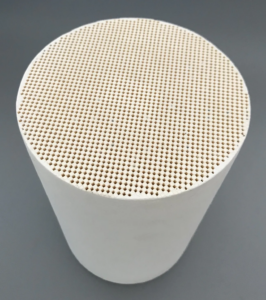
SCR Catalyst Substrate: Hualian uses honeycomb structures (200–300 CPSI) made of ceramic (cordierite) or metal (Fe-Cr-Al alloy), maximizing surface area for catalytic reactions while minimizing backpressure.
Active Catalytic Materials: Zeolite (Fe/Cu) or V₂O₅-TiO₂—these are the “reaction sites” where NOₓ and AdBlue interact to drive conversion.
Diesel Oxidation Catalyst (DOC): Installed upstream of the SCR catalyst, DOCs oxidize 95%+ of CO/HC, raise exhaust temperature (critical for low-temperature SCR activation), and convert ~10–20% of NO to NO₂—speeding up SCR reactions by 30%.
AdBlue Injection System: Precisely meters AdBlue into the exhaust stream (upstream of the SCR catalyst) based on engine load and NOₓ output.
Mixer: Ensures uniform blending of AdBlue vapor and exhaust gas, preventing “channeling” (uneven flow) that reduces conversion efficiency.
Hualian’s integrated SCR-DOC systems are pre-calibrated for diesel engines, eliminating compatibility issues and simplifying installation for 2B clients.
How Does SCR Catalyst Work? 4 Key Stages (with DOC Synergy)
The SCR catalyst’s operation is a precision-driven, sequential process—with diesel oxidation catalysts playing a critical supporting role:
Stage 1: Pre-Treatment by Diesel Oxidation Catalysts
First, exhaust flows through the diesel oxidation catalyst (DOC). Here, three critical tasks occur:
Oxidizes CO and HC into harmless CO₂ and H₂O (addressing these pollutants upfront).
Raises exhaust temperature by 10–30°C (via exothermic oxidation), ensuring the SCR catalyst reaches its activation temperature (≥200°C).
Converts a small portion of NO (nitric oxide) to NO₂ (nitrogen dioxide)—this NO/NO₂ mix accelerates SCR reactions, especially at low temperatures.
Hualian’s DOCs are engineered to perfectly complement their SCR catalysts, optimizing the exhaust conditions for maximum NOₓ conversion.
Stage 2: AdBlue Injection & Vaporization
After the DOC, the AdBlue injection system sprays a controlled amount of AdBlue (a 32.5% urea-water solution) into the hot exhaust. The exhaust heat vaporizes AdBlue, converting it into ammonia (NH₃)—the reducing agent that drives the SCR reaction.
Hualian’s precision injectors and mixers prevent AdBlue “caking” (a common issue with low-quality systems) and ensure uniform NH₃ distribution across the SCR catalyst.
Stage 3: Catalytic Reaction on the SCR Catalyst
The NH₃-rich exhaust flows through the SCR catalyst’s honeycomb substrate, where the selective reaction takes place:
Low-Temperature Reaction (Zeolite Catalysts): NH₃ reacts with NOₓ (NO + NO₂) to form N₂ and H₂O, with Fe/Cu zeolite acting as a catalyst. This works efficiently at 200–350°C, ideal for urban driving or light-duty use.
High-Temperature Reaction (V₂O₅-TiO₂ Catalysts): NH₃ + NOₓ → N₂ + H₂O, stabilized by WO₃/MoO₃ to prevent catalyst degradation at 280–420°C (common in heavy-duty or industrial operation).
Hualian’s SCR catalysts achieve ≥90% NOₓ conversion efficiency—exceeding Euro 6’s 85% requirement—with minimal NH₃ slip (≤10 ppm), avoiding secondary pollution.
Stage 4: Clean Exhaust Output
After passing through the SCR catalyst, the exhaust contains near-zero NOₓ, CO, and HC—fully compliant with Euro 6/China VI standards. The harmless N₂ and H₂O are released into the atmosphere, with no impact on engine power or fuel efficiency.
Why Choose Trusted SCR Catalyst Suppliers Like Hualian Catalyst?
For 2B clients, the performance of an SCR catalyst depends as much on the technology as on the supplier’s expertise. Here’s how Hualian stands out as a leading SCR catalyst suppliers:
Synergized SCR-DOC Systems: Hualian designs both diesel oxidation catalysts and SCR catalysts as integrated solutions, ensuring perfect compatibility (no mismatched components that reduce efficiency).
Diesel Engine Customization: Tailored formulations (zeolite or V₂O₅-TiO₂) and substrate sizes (50–200 mm length) for 10–2000 kW diesel engines—from passenger cars to industrial boilers.
Global Compliance: Products meet Euro 3–6, China VI, and EPA Tier 4 standards, with ISO 9001/IATF 16949 certifications and batch-level test reports for regulatory audits.
Durability & Support: Hualian’s SCR catalysts last 8,000+ operating hours (150,000+ km for vehicles), with 24/7 technical support for AdBlue system calibration and troubleshooting.
Proven Track Record: Trusted by 5,000+ global 2B clients, with 278,000+ successful installations across fleets, industrial facilities, and OEM production lines.
SCR Catalyst: The Cornerstone of Diesel NOₓ Compliance
For 2B clients operating diesel equipment, SCR catalyst technology—paired with high-quality diesel oxidation catalysts—is the most reliable, cost-effective way to meet strict NOₓ emission standards. Unlike standalone solutions, SCR systems deliver compliance without sacrificing engine power, increasing fuel consumption, or adding excessive maintenance downtime.
As one of the most trusted scr catalyst suppliers, Hualian Catalyst doesn’t just provide components—we deliver end-to-end emission control solutions. Our integrated SCR-DOC systems are engineered for the unique demands of diesel engines, backed by decades of expertise and global support. Whether you’re retrofitting a fleet, upgrading industrial machinery, or manufacturing Euro 6-compliant diesel equipment, Hualian’s SCR catalysts and diesel oxidation catalysts ensure you meet standards with confidence, minimize operational risks, and maximize long-term value.
Choose Hualian Catalyst for SCR solutions that work as hard as your diesel engines—reliable, efficient, and compliant, today and tomorrow.