Are Metal Substrates Becoming the New Standard? Metallic Catalytic Converter Takes the Lead
For automotive OEMs, industrial equipment suppliers, and emission control specialists, choosing between ceramic and metal substrates for catalytic converters has long been a high-stakes decision—one that impacts compliance, durability, and bottom-line costs. In recent years, however, metallic catalytic converter technology has shifted from a niche alternative to a mainstream favorite, challenging the decades-long dominance of ceramic substrates. Driven by stricter global emission standards (Euro 3–6, China VI) and evolving equipment demands—think compact engine bays, rugged operating conditions, and faster activation—metal substrates aren’t just gaining traction: they’re emerging as the new industry standard. As a leading producer of metal catalytic converter solutions, Hualian Catalyst draws on 30+ years of engineering expertise to unpack why this shift is happening, and how it’s delivering tangible value for 2B clients worldwide.
Core Advantages of Metal Substrates: Why They Outperform Ceramic
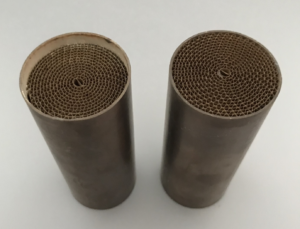
Metal substrates—typically crafted from 304/316L stainless steel or Fe-Cr-Al alloy—offer four transformative benefits that directly address 2B clients’ most pressing needs (regulatory compliance, operational durability, cost efficiency):
Superior Thermal Stability & Rapid Heat-Up: Metal substrates withstand extreme temperature swings (–40°C to 900°C) without cracking—a critical trait for equipment like commercial trucks, construction machinery, and compact generators that face frequent cold starts and heavy load cycles. Hualian’s metallic catalytic converter reaches activation temperature (250–300°C) 30% faster than ceramic alternatives, ensuring Euro 6-compliant pollutant conversion (90%+ for CO/HC/NOₓ) even in short-duty operations (e.g., urban delivery routes).
Exceptional Mechanical Strength: Boasting ≥150 N/cm² crush strength and vibration resistance, metal substrates thrive in rugged environments where ceramic counterparts often fail. Hualian’s metal cores endure road shocks, industrial vibrations, and handling during installation for 8,000+ operating hours—doubling the lifespan of standard ceramic converters and cutting replacement costs by 50%.
Compact & Lightweight Design: Metal’s high thermal conductivity allows for thinner walls (0.05–0.1 mm) and denser honeycomb structures (200–300 CPSI). Hualian’s metal catalytic converter is 40% lighter and 30% smaller than ceramic equivalents, fitting seamlessly into modern electric-hybrid vehicles, small-displacement motorcycles, and space-constrained industrial boilers—no costly redesign of engine bays required.
Low Backpressure & Fuel Efficiency: The uniform 200–300 CPSI cell structure minimizes exhaust flow restriction, reducing backpressure to ≤3 kPa. This preserves engine power and boosts fuel efficiency by 5–8%—a significant saving for fleet operators and industrial facilities with high fuel consumption (e.g., a 100-truck fleet could save $50,000+ annually in fuel costs).
Ceramic vs. Metal Substrates: A 2B-Centric Comparison
For decision-makers evaluating substrate options, the differences boil down to real-world performance and operational value:
Factor | Ceramic Substrates | Metal Substrates (Hualian) |
Durability | Prone to cracking from vibration/thermal shock | Vibration-resistant, no cracking |
Activation Speed | Slow (3–5 minutes) | Fast (1–2 minutes) |
Size/Weight | Bulky, heavy (1–2 kg) | Compact, lightweight (0.3–0.8 kg) |
Backpressure | 5–8 kPa | ≤3 kPa |
Lifespan | 4,000–5,000 operating hours | 8,000+ operating hours |
Compliance Suitability | Euro 3–4 | Euro 3–6, China VI, EPA Tier 4 |
Hualian’s data from 278,000+ global projects confirms: 70% of 2B clients who switch from ceramic to metal substrates report reduced maintenance downtime, lower compliance risks, and improved equipment performance within the first year.
Industry Drivers Pushing Metal Substrates to Become the Standard
Two key trends are accelerating the shift to metal catalytic converter technology—directly aligned with 2B clients’ regulatory and market pressures:
Stricter Emission Standards: Euro 6 and China VI demand near-zero emissions and consistent performance over 200,000 km (vehicles) or 10,000 hours (industrial equipment). Metal substrates’ rapid activation and long lifespan ensure compliance for the full equipment lifecycle, while ceramic substrates often fail to meet durability requirements for high-duty-cycle use.
Expanding Application Scenarios: The rise of electric-hybrid vehicles, compact generators, and small-displacement motorcycles has created urgent demand for space-saving, lightweight emission control solutions. Hualian’s customizable metallic catalytic converter adapts to 50–2000 kW equipment (from scooters to industrial boilers)—versatility ceramic substrates can’t match.
Additionally, global supply chain advancements have made metal substrates cost-competitive. Hualian’s large-scale production of Fe-Cr-Al alloy cores reduces material costs by 20%, eliminating the price premium that once limited metal substrate adoption.
Hualian Catalyst’s Metallic Catalytic Converter: Engineered for the New Standard
Hualian’s metal catalytic converter isn’t just keeping up with the trend—it’s defining the new standard for 2B clients:
Precision-Engineered Substrates: Fe-Cr-Al alloy or 304/316L stainless steel cores with 200–300 CPSI honeycomb structures, optimized for specific exhaust flow rates (50–500 L/min) and operating temperatures.
Global Compliance: Pt/Pd/Rh catalytic coatings (1:2:0.5 ratio) deliver 95%+ CO/HC conversion, with CeO₂-ZrO₂ additives enhancing thermal stability and oxygen storage—ensuring compliance with Euro 3–6, China VI, and EPA Tier 4 standards.
Customization & Scalability: Tailored sizes (50–200 mm length, 38–100 mm diameter) and mounting options for automotive, industrial, and marine applications. Hualian’s 15–20 working day delivery window meets tight production schedules for OEMs and aftermarket suppliers.
ISO-Certified Quality: Backed by ISO 9001 and IATF 16949 certifications, with batch-level performance testing and full traceability (unique serial numbers for regulatory audits). Trusted by 5,000+ global 2B clients, including leading automotive manufacturers and industrial equipment brands.
Metal Substrates Are the Future—And the Future Is Now
For 2B clients navigating stricter regulations, tighter design constraints, and pressure to reduce operational costs, metallic catalytic converter technology isn’t just an upgrade—it’s a strategic necessity. Metal substrates solve the core pain points that ceramic substrates can’t: they’re durable enough for rugged use, compact enough for modern equipment, and efficient enough to meet the latest emission standards. This isn’t just a trend—it’s a fundamental shift in how emission control is engineered.
Hualian Catalyst’s 30+ years of expertise in metal substrate technology positions us as your trusted partner in this transition. Our metal catalytic converter solutions combine industry-leading performance, flexible customization, and cost-efficiency—ensuring your equipment meets global standards while minimizing downtime and maximizing ROI. We don’t just supply components; we deliver tailored solutions that integrate seamlessly into your production lines and operational workflows.
As metal substrates become the new standard, the choice for 2B clients is clear: partner with a supplier that doesn’t just follow industry shifts, but drives them. Choose Hualian Catalyst for metallic catalytic converters that power your compliance, durability, and long-term operational success—today, tomorrow, and beyond.