How Are Metal Catalytic Converters Made? Inside the Manufacturing of Motorcycle Exhaust Catalytic Converters
For motorcycle manufacturers, aftermarket suppliers, and fleet operators, meeting Euro 3–6 emission standards depends on one critical component: the metal catalytic converter. Unlike bulkier ceramic alternatives, motorcycle exhaust catalytic converter models are prized for their compact design, vibration resistance, and rapid heat-up—essential traits for two-wheeled vehicles with tight engine bays and frequent temperature fluctuations. But what goes into crafting these precision-engineered emission control solutions? As a leading producer of motorcycle catalyst systems, Hualian Catalyst draws on 30+ years of expertise in metal catalytic converter manufacturing to pull back the curtain on the process, highlighting motorcycle-specific optimizations and quality standards that set industry benchmarks.
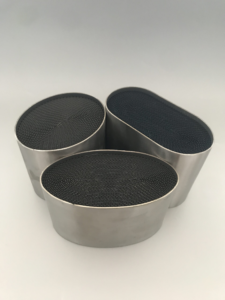
Motorcycle Exhaust Catalytic Converter: Core Manufacturing Principles
Metal catalytic converters stand out for their metallic substrates (typically stainless steel or Fe-Cr-Al alloy), which offer superior mechanical strength and thermal conductivity compared to ceramic. For motorcycles, these traits are non-negotiable—they must withstand road vibrations, fit in confined spaces, and convert pollutants efficiently even at low exhaust temperatures (common in urban stop-and-go riding). Hualian’s manufacturing process adheres to strict Euro 3–6 requirements, focusing on three core goals: 90%+ conversion of CO/HC/NOₓ, lightweight design (to avoid affecting motorcycle handling), and long-term durability (8,000+ operating hours). Every motorcycle catalyst undergoes 6 key production stages, each tailored to the unique demands of two-wheeled vehicles.
Metal Substrate Preparation: The Durable Backbone
The substrate is the foundation of any metal catalytic converter—Hualian’s motorcycle-specific substrates are engineered for strength and efficiency:
Material Selection: High-grade 304/316L stainless steel or Fe-Cr-Al alloy is chosen for its corrosion resistance and heat tolerance (up to 900°C). For motorcycles, the substrate uses thin-walled sheets (0.05–0.1 mm) to minimize weight (typically 200–500 g) while maintaining ≥150 N/cm² crush strength—critical for withstanding vibrations from rough roads.
Corrugation & Winding: Metal sheets are precision-corrugated to create a honeycomb structure with 200–300 CPSI (cells per square inch)—optimized for motorcycle exhaust flow rates (50–200 L/min). The corrugated sheets are then wound around a central tube and laser-welded to form a compact monolith (50–100 mm in length, tailored to 50–1000 cc motorcycle engines).
Cleaning & Pretreatment: The substrate is degreased and acid-etched to create a rough surface, ensuring strong adhesion of the catalyst coating. Hualian’s pretreatment process meets ISO 9001 standards, eliminating oil or debris that could reduce conversion efficiency.
Catalyst Slurry Preparation: The “Active Ingredient”
The catalyst coating—where pollutant conversion occurs—is a precisely blended slurry of precious metals and support materials:
Precious Metal Integration: Hualian’s motorcycle catalyst uses Pt (platinum), Pd (palladium), and Rh (rhodium) in optimized ratios (e.g., 1:2:0.5 for Euro 6 compliance). These metals are dispersed as 1–5 nm nanoparticles to maximize surface area, ensuring 95%+ CO/HC conversion even at 250–300°C (critical for motorcycle cold starts).
Support & Additive Blend: Precious metals are mixed with Al₂O₃ (alumina) as a support, plus CeO₂ (cerium oxide) to enhance oxygen storage and thermal stability. For motorcycles, Hualian adds ZrO₂ (zirconia) as an anti-sintering additive, preventing metal clumping during frequent start-stop cycles.
Slurry Homogenization: The mixture is milled to a uniform particle size (<10 μm) and adjusted to a viscosity that ensures even coating—avoiding gaps that reduce pollutant capture.
Coating Application: Precision for Uniform Performance
Applying the slurry evenly to the metal substrate is make-or-break for efficiency:
Dip-Coating Process: The metal monolith is dipped into the slurry, with controlled withdrawal speed (5–10 mm/s) to achieve a 50–100 μm coating thickness. Hualian’s automated lines ensure consistent coverage across all 200–300 CPSI cells—eliminating hotspots that degrade performance.
Excess Removal & Drying: Air knives blow off excess slurry, and the substrate is dried at 120°C for 2–4 hours to remove moisture. For motorcycles, the coating load is optimized (1–2 g/in³) to balance performance and weight, avoiding strain on the engine.
High-Temperature Activation: Converting Slurry to Functional Catalyst
Drying alone won’t activate the catalyst—high-temperature calcination and reduction are critical:
Calcination: The coated substrate is heated to 500–600°C in an oxygen-controlled tunnel furnace, converting the slurry into a stable oxide layer that bonds tightly to the metal substrate.
Reduction Treatment: A final hydrogen gas treatment (300–400°C) converts metal oxides to their active metallic form, enabling pollutant conversion. Hualian’s furnaces maintain ±5°C precision to avoid coating cracking.
Assembly & Encapsulation: Tailored for Motorcycles
The activated substrate is assembled into a finished motorcycle exhaust catalytic converter with motorcycle-specific design tweaks:
Shell Fabrication: A stainless steel shell (38–51 mm diameter, matching standard motorcycle exhaust pipes) is formed and welded to the substrate. A thermal insulation layer is added to protect surrounding components from high heat.
Vibration-Resistant Mounting: High-temperature gaskets (graphite or metal-reinforced) prevent leaks, and mounting brackets are welded to absorb vibrations—critical for avoiding substrate damage on rough terrain.
Traceability Labeling: Each converter gets a unique serial number, compliance standard (Euro 3–6), and Hualian logo—enabling full traceability for regulatory audits.
Quality Control & Compliance Testing: Meeting Global Standards
No motorcycle catalyst leaves Hualian’s facility without rigorous testing:
Performance Testing: Portable emission analyzers verify ≥90% CO/HC/NOₓ conversion (Euro 6 requirement), with tests simulating real-world riding (stop-and-go, high-speed runs).
Mechanical & Thermal Testing: Converters undergo vibration testing (10–2000 Hz) and thermal shock cycles (250–800°C) to ensure durability. Pressure drop testing confirms backpressure ≤3 kPa—preserving motorcycle engine power.
Certification: Every batch meets Euro 3–6, China VI, and EPA standards, with test reports provided to clients. Hualian’s IATF 16949 certification ensures consistency across 5,000+ global 2B partnerships.
Hualian Catalyst: Motorcycle Catalyst Manufacturing Excellence
What sets Hualian’s motorcycle exhaust catalytic converter apart is its motorcycle-specific engineering at every step—from compact substrate sizing to vibration-resistant assembly. With 278,000+ successful projects, Hualian delivers:
Custom designs for 50–1000 cc motorcycles (scooters to superbikes).
Euro 3–6 compliance with 8,000+ operating hours lifespan.
Fast delivery (15–20 working days for custom orders) and 24/7 technical support.
For motorcycle manufacturers and aftermarket suppliers, Hualian’s process ensures converters that fit, perform, and last—even in the toughest riding conditions.
Trust Hualian Catalyst for Precision-Made Motorcycle Catalysts
Crafting a metal catalytic converter for motorcycles is a masterclass in balancing precision, durability, and compactness—and Hualian Catalyst has perfected this art over three decades. Our motorcycle catalyst and motorcycle exhaust catalytic converter products are engineered not just to meet emission standards, but to thrive in the unique demands of two-wheeled vehicles: tight spaces, frequent vibrations, and variable operating temperatures.
Whether you’re building new motorcycles or supplying aftermarket parts, Hualian doesn’t just deliver a component—we deliver peace of mind. With customizable designs, rigorous quality control, and global compliance, we’re the partner motorcycle industry leaders rely on to stay ahead of regulations and keep riders moving. Choose Hualian Catalyst for metal catalytic converters that are as tough, efficient, and reliable as the motorcycles they power.