As a manufacturer deeply involved in emission-control technology, Hualian Catalyst focuses on developing solutions that support experienced users and system integrators who require reliable performance in diesel applications. When discussing what a diesel oxidation catalytic converter does, we rely on our practical experience in engine after-treatment systems. A diesel oxidation catalytic converter plays a core role in oxidizing carbon monoxide, hydrocarbons, and soluble organic fractions to support cleaner and more stable engine operation. In our daily work with diesel engines and industrial equipment, we integrate this converter into after-treatment assemblies where precise oxidation control is required. The same functional principle also guides the design of our doc diesel oxidation catalyst, which we apply across multiple regulated environments.
How the Oxidation Process Supports Emission Control
The oxidation reaction within a diesel oxidation catalytic converter involves controlled exposure of exhaust gases to a catalytically active surface. In our engineering practice, we use this process to transform CO, HC, and SOF into CO₂ and H₂O, enabling the after-treatment system to operate with predictable efficiency. By understanding what a diesel oxidation catalyst does in real operating conditions, we design structures that maintain consistent gas flow, low pressure drop, and high thermal stability. These characteristics are central to the performance of any diesel oxidation catalytic converter, especially in non-road machinery, heavy-duty vehicles, and construction equipment where operational loads vary. When applying a doc diesel oxidation catalyst in these systems, we evaluate exhaust temperature ranges, vibration resistance, and expected durability to ensure that the oxidation function remains effective through extended use.
Application of Honeycomb Ceramic DOC Catalyst
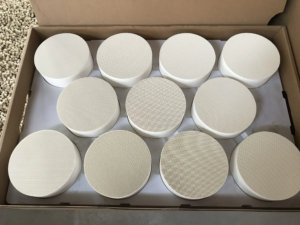
In explaining what a diesel oxidation catalyst does, our work frequently centers on the honeycomb ceramic configuration. The DOC Catalyst-Honeycomb Ceramic Structure we provide uses a durable ceramic substrate that supports the catalytic coating throughout continuous exposure to high temperatures. This design ensures efficient conversion within compact installation spaces. The honeycomb ceramic DOC Catalyst serves as the attachment location for catalytic oxidation in the after-treatment assembly of internal combustion engines. When applying a diesel oxidation catalytic converter of this type, we adjust cell density, dimensions, and coating formulation based on the regulatory framework. Our doc diesel oxidation catalyst options include custom configurations that support Euro III–VI and EPA requirements, allowing customers to match performance specifications with their operational demands.
Conclusion: The Operational Role of a Diesel Oxidation Catalyst
In conclusion, understanding what a diesel oxidation catalyst does allows us to design solutions that integrate smoothly into professional diesel systems. Through optimized oxidation of CO, HC, and SOF, a properly configured diesel oxidation catalytic converter supports stable emission control across diverse machinery. By applying the principles behind our doc diesel oxidation catalyst, we ensure that our ceramic honeycomb DOC Catalyst continues to meet regulatory objectives and long-term operational expectations for experienced users.