A city vehicle can leave a depot, idle at junctions, and stop repeatedly before its exhaust reaches a stable hot condition Off-road machinery may alternate between loaded work and long low-load intervals.
In both cases, a headline peak temperature describes only part of the duty cycle. For low-temperature nox reduction, the operating trace pairs each cool interval with NOx mass and exhaust flow so the burden of that interval can be assessed.

Follow the Cool Periods Across a Workday
Cold start, idle, light load, sustained work, and brief peaks divide an urban route into distinct thermal phases. The hours or events at each temperature matter because a selective catalytic reduction catalyst has to operate in moving exhaust, not at a single catalogue point.
Pairing exhaust flow and NOx output with temperature distinguishes a cool interval that produces little NOx from one with a large NOx mass flow Position in the exhaust line also changes the temperature the honeycomb actually sees.
Urban duty and off-road duty are related but not identical. Frequent stops can interrupt warm operation on a vehicle. Machinery may hold a productive load for a period, then cool during idle or travel between sites.
A proposed low-temperature formulation needs to be considered against these patterns rather than matched to the equipment category alone. The relevant question is where the exhaust data cluster, including the tails of the distribution that a simple average hides.
The same engine can present different temperatures at different positions in the exhaust line. A catalyst placed farther from the engine may receive cooler gas after heat has been lost through upstream components and pipework.
The relevant temperature profile is the one measured or estimated at the proposed mounting position. This is the temperature the SCR catalyst will actually experience. Without this check, a washcoat may appear suitable on an engine-out chart while the installed honeycomb spends most of its time below the stated temperature range.
Low-temperature operation also affects reductant use. Ammonia from urea dosing must meet NOx at an active surface under workable conditions. Adding reductant during a period when conversion is limited can leave ammonia downstream. Withholding reductant, however, leaves NOx untreated.
The dosing strategy and the catalyst temperature window must be evaluated together. Neither a formulation label nor a low minimum temperature guarantees installed conversion across every start and stop.
Locate the Cold Window in the Chemistry Range
A work cycle concentrated near 150°C points toward a different chemistry discussion from one that reaches 500°C regularly. The coolest formulation in our Hualian Catalyst range uses Mn-containing oxides, listed for 130–250°C. The other listed windows begin higher: Cu/zeolite at 190–550°C, vanadium-based metal oxides at 230–470°C, and Fe/zeolite at 450–620°C.
These are the temperature windows we list for each washcoat formulation. They are not claims that each chemistry has equal activity throughout its interval. Overlap does not make the formulations interchangeable; peak heat, operating time, and application requirements still matter.
The coolest portions of an urban or intermittent off-road cycle make the Mn-containing option worth examining first. A cycle that moves between moderate and hotter exhaust may lead to Cu/zeolite, while the vanadium-based and Fe/zeolite options require attention to time spent at their higher starting temperatures.
The measured profile and applicable testing, rather than the lowest starting number alone, determine which candidate remains suitable across the full cycle.
The amount of NOx emitted during each temperature band determines how each candidate should be weighted in the selection process. If most emissions occur while the exhaust is below the chosen formulation’s useful range, strong results at a short hot peak cannot by themselves resolve the urban-duty problem.
Conversely, an off-road engine with long loaded periods may place more value on performance at higher temperatures. A temperature histogram paired with NOx mass across the same cycle provides a data-driven basis for comparison.
Account for Vibration and Thermal Cycling
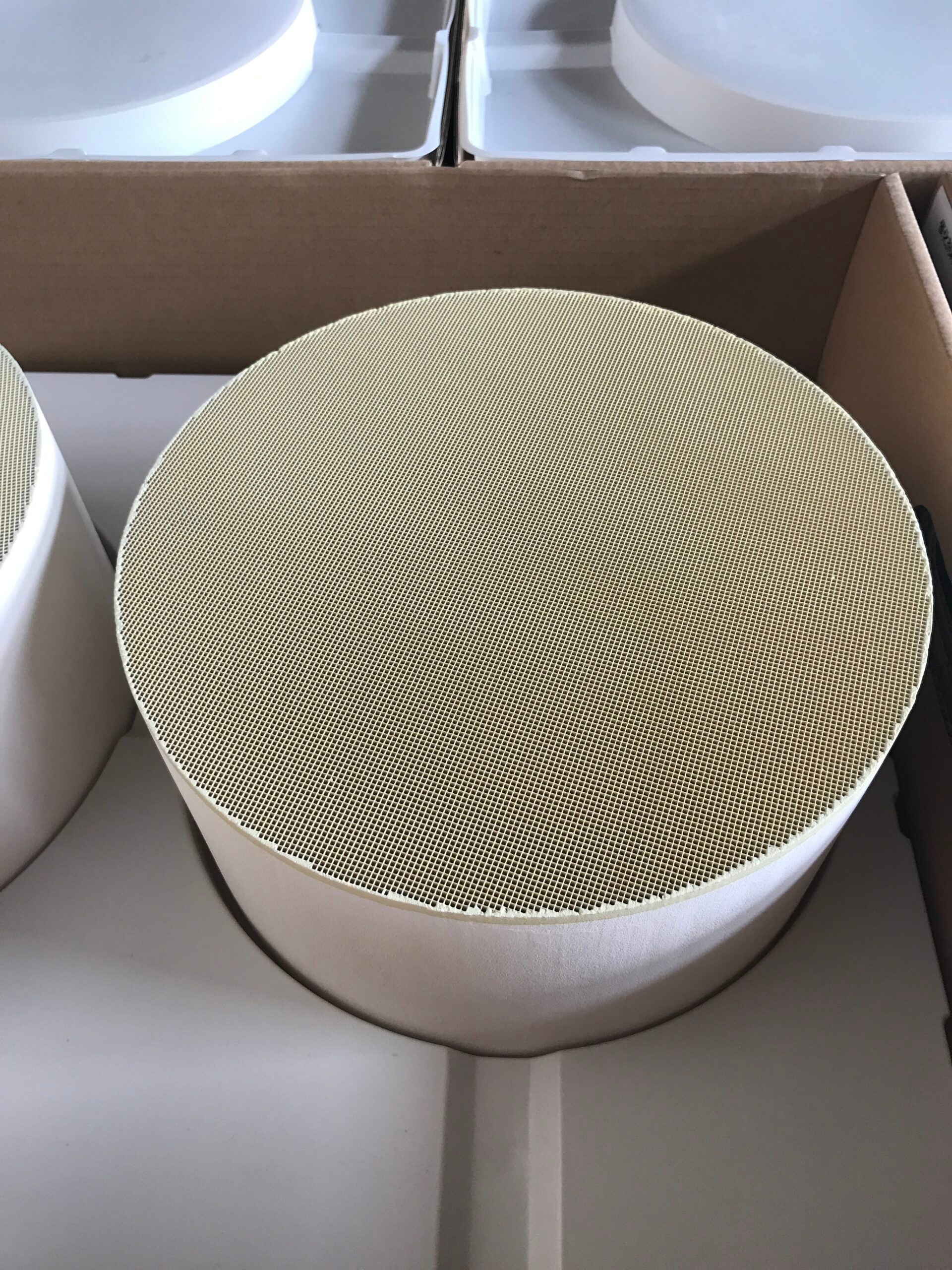
A machine’s changing load and mounting conditions expose its honeycomb to thermal and mechanical cycles. The honeycomb design in our supplied information emphasizes high surface area and low pressure drop, so contact with the catalyst can be considered without ignoring engine backpressure.
Low thermal expansion and resistance to heat shock and vibration are also listed. Those properties matter when machinery moves between hot load and cooler idle, or when an off-road installation experiences mechanical vibration.
A selective catalytic reduction catalyst for either setting has to fit its mounting space and exhaust flow while surviving the actual temperature changes. Washcoat range, channel design, and mechanical demands are one specification, not separate shopping lists. We would use duty-cycle data to narrow the chemistry, then consider honeycomb geometry and the installation conditions in which that chemistry will operate.
The useful output of a route or work-cycle review is a map of temperatures and NOx mass across actual operation. The stated ranges indicate where to look; measured exhaust behavior shows which intervals deserve the most attention. A city route or work cycle, rather than the machine label, ultimately defines the low-temperature NOx reduction task.