A soot filter cannot reduce NOx by trapping it, and an SCR catalyst cannot collect soot as a filter does. Diesel exhaust needs both functions when particulate matter and nitrogen oxides must be controlled. Their performance is linked, however, because upstream reactions alter the temperature and gas composition reaching each later component.
The DOC is one important part of that link. Examining the path of soot, NO, NO₂, and heat through an aftertreatment line explains why a diesel oxidation catalyst can influence a filter and an SCR unit without performing either device’s main task itself.
Assign Each Pollutant to Its Treatment Step
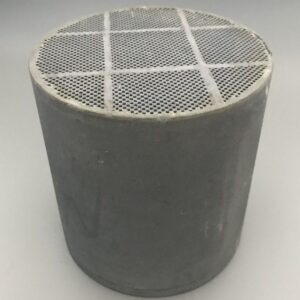
The DPF retains solid particles in a porous wall-flow structure. As soot accumulates, it needs regeneration to restore capacity and manage pressure loss. SCR addresses gaseous NOx through a different reaction: ammonia derived from the reductant reacts over an SCR catalyst to form nitrogen and water under suitable conditions.
Neither function can be inferred from the other. A complete system discussion therefore identifies the pollutant each unit treats before it claims a combined result.
The oxidation catalyst upstream of these devices works on compounds such as hydrocarbons and can also change the balance of NO and NO₂. NO₂ is relevant because it can assist passive soot oxidation in a DPF and participate in the fast-SCR reaction downstream.
Its usefulness depends on the whole configuration and operating temperature; simply increasing one gas species is not a universal design rule. The component order and control strategy determine where the altered stream goes next.
In a diesel oxidation catalyst application, exhaust temperature matters alongside composition. A filter cannot regenerate effectively whenever soot is present; the thermal conditions must support the intended passive or active process.
SCR conversion also depends on the temperature and NO/NO₂ mix reaching its catalyst. Treating these conditions as system inputs keeps each component’s role clear without assigning filtration or NOx reduction directly to the DOC.
The filter’s condition also changes the system picture over time. As captured soot accumulates, the pressure required to move exhaust through the DPF can rise.
Regeneration addresses that accumulated material, but its timing depends on the available exhaust conditions and control strategy. This rising filter load is separate from the DOC’s oxidation task, even though the DOC can influence the conditions under which regeneration occurs.
Follow the DOC’s Contribution to DPF Regeneration
Passive DPF regeneration uses suitable exhaust conditions to oxidize collected soot during operation. The DOC can oxidize NO to NO₂, which can improve that passive pathway.
The benefit varies with temperature, flow, and the amount of NO available. If the operating cycle does not provide sufficient conditions, the system may need active regeneration instead of relying on passive soot removal alone.
Active regeneration introduces additional heat. In the supplied information, injected fuel can be catalytically ignited over the DOC to raise exhaust temperature and initiate the DPF’s active regeneration process.
This describes a system relationship, not a claim that a DOC stores soot or that every injection strategy is identical. Fuel delivery, placement, temperature measurement, and protection of downstream components remain matters for the specific aftertreatment design.
We describe our DOC at Hualian Catalyst as able to oxidize hydrocarbons, raise exhaust temperature in an active-regeneration strategy, and increase the NO₂/NOx ratio. Those upstream effects can support a DPF, but the final regeneration outcome belongs to the integrated system and its duty cycle.
For an oxidation catalyst to contribute as intended, its position and operating conditions must be considered alongside the filter rather than discussed as an isolated product.
The temperature increase used for active regeneration must also be understood as a controlled event. Heat generated upstream reaches more than the filter. Its effect depends on the placement and thermal limits of later components.
A useful system description therefore identifies where temperature is measured and which component the control action is intended to target. The DOC’s ability to assist ignition explains a mechanism, while the complete control sequence remains specific to the installation.
Connect the Gas Mixture to SCR Conditions
Fast SCR depends on a useful mixture of NO and NO₂ with ammonia at the SCR catalyst. Oxidation of NO to NO₂ upstream can help create that mixture. The DOC thus influences the gas presented to SCR while the SCR component performs the NOx-reduction reaction.
Too little attention to the upstream balance can make a downstream catalyst appear to be the sole cause of a system result, even when its inlet conditions have changed.
The diesel oxidation catalyst also affects the system through heat and hydrocarbon oxidation, especially where the operating strategy uses it to assist DPF regeneration. These interactions do not mean all devices should be collapsed into one performance figure.
A DPF captures particulate matter, SCR treats NOx, and the upstream DOC modifies conditions that can support both. Any claim about combined emissions performance requires the chosen layout, reductant strategy, duty cycle, and test basis.
When reviewing an integrated design, the useful questions follow the exhaust. What reaches the DPF, under which temperature conditions can soot be removed, and what NO/NO₂ balance reaches SCR?
DOC oxidation alters what reaches the filter and SCR unit; filtration and NOx conversion need separate evidence at matching conditions. The system works by coordinating distinct functions, not by asking one device to perform them all.