At the SCR inlet, NO and NO₂ flow with exhaust into which ammonia has been dosed from urea solution. Selective catalytic reduction needs a reductant, an active catalyst, and suitable exhaust conditions to convert nitrogen oxides into nitrogen and water. Urea dosing supplies ammonia for the reaction, while the honeycomb presents a coated surface to the moving gas.
Understanding what reacts and what the substrate contributes prevents us from mistaking the physical shape for the chemical process. The standard and fast SCR equations show where the NO/NO₂ mixture enters the chemistry. They also explain why dosing must be considered together with the substrate.
Begin With the Reactants, Not the Hardware
Diesel NOx is a mixture in which NO and NO₂ can both matter to SCR operation. Ammonia is the reducing agent; in a urea-SCR system, it is generated from the dosed urea solution before reacting at the catalyst.
The reaction requires the relevant gases to contact the active surface at a workable temperature. A honeycomb with excellent flow but no appropriate active formulation would not control NOx.
The selective catalytic reduction catalyst supplies sites that promote the desired reaction. “Selective” refers to steering the reductant toward NOx reduction rather than merely releasing or consuming ammonia without the intended outcome.
The inlet NO/NO₂ balance affects which reaction pathway is available. Exhaust temperature and flow also affect the time and conditions for contact. These dependencies explain why a single catalyst label cannot specify conversion for every engine and duty cycle.
The reductant supply has to match the gas entering the unit. Too little ammonia leaves part of the NOx untreated; too much can pass through as ammonia slip if it is not consumed or handled downstream.
Dosing control and catalyst design must therefore be discussed as one system, even though they are different components. A selective catalytic reduction specification is incomplete when it names only the substrate dimensions.
Read the Standard and Fast SCR Reactions
The standard SCR equation in the supplied information is 4NH₃ + 4NO + O₂ → 4N₂ + 6H₂O. It describes ammonia reacting with NO in the presence of oxygen to produce nitrogen and water.
The fast SCR equation is 4NH₃ + 2NO + 2NO₂ → 4N₂ + 6H₂O. Here both NO and NO₂ appear among the reactants. These equations clarify why the NO/NO₂ ratio matters; they do not by themselves predict a percentage of conversion in an installed vehicle.
A selective catalytic reduction catalyst works within gas that changes as the engine operates. Temperature, NOx concentration, and reductant delivery can vary across a trip or work cycle. The standard and fast reaction routes may therefore contribute differently at different moments.
A useful evaluation states which operating points are important and measures the outcome under those conditions. Copying a reaction equation into a product sheet without the related test context would leave the practical engineering question unanswered.
The equations also separate SCR from adjacent exhaust tasks. A DPF traps particulate matter, while a DOC can alter hydrocarbons or the NO/NO₂ balance upstream.
Those functions can support an integrated aftertreatment line, but the SCR unit performs the NOx reduction reaction with ammonia. Naming each role avoids crediting the SCR honeycomb with soot filtration or asking a DPF to carry out chemical NOx reduction.
The coefficients in the equations are a useful accounting guide: four ammonia molecules appear with four NO molecules in the standard route, while the fast route includes both NO and NO₂.
An installed system has changing concentrations rather than a fixed textbook mixture. The equations show what can react, while measured gas composition shows which route may be available at a given operating point.
Place the Chemistry on a Workable Honeycomb
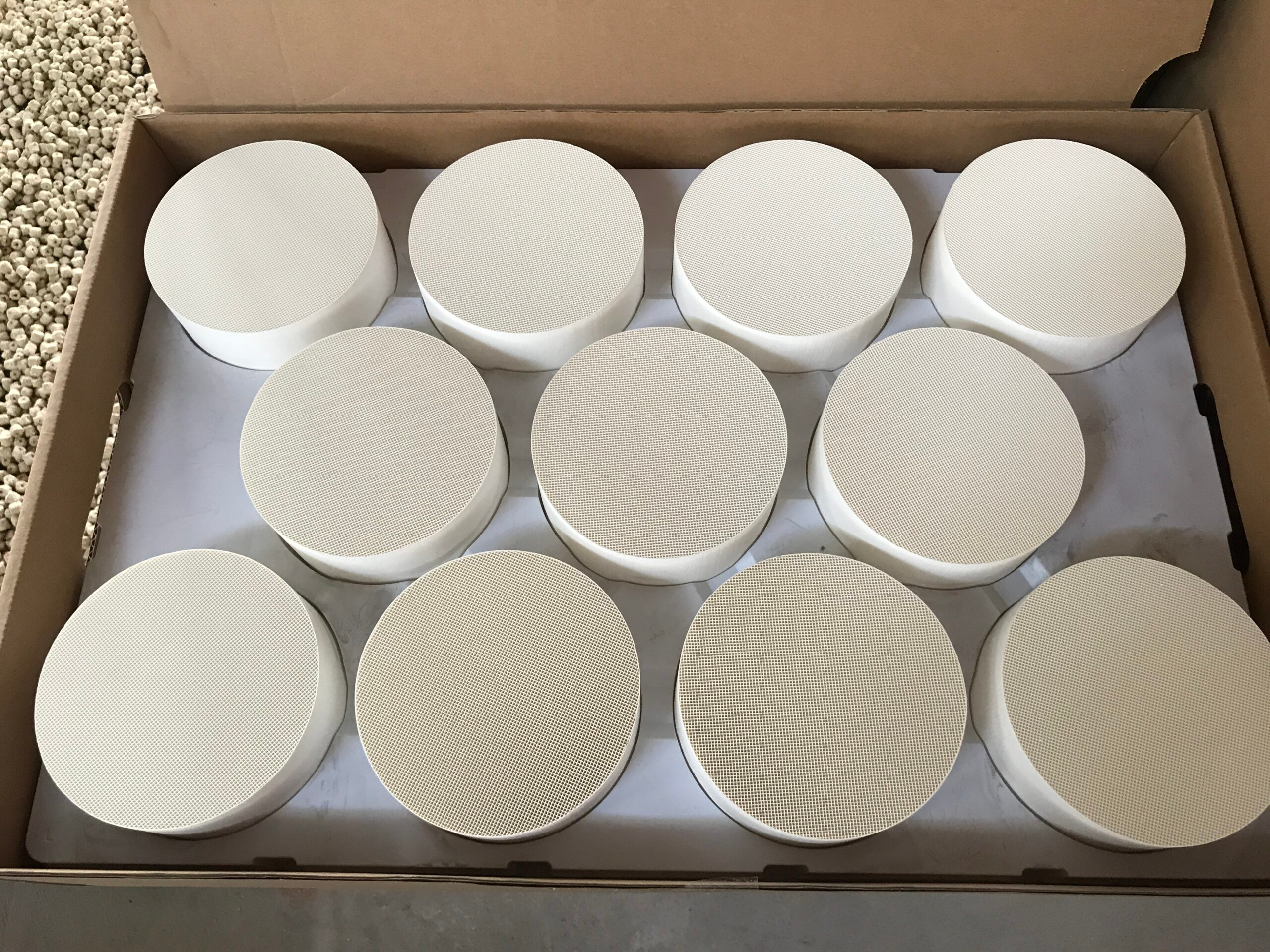
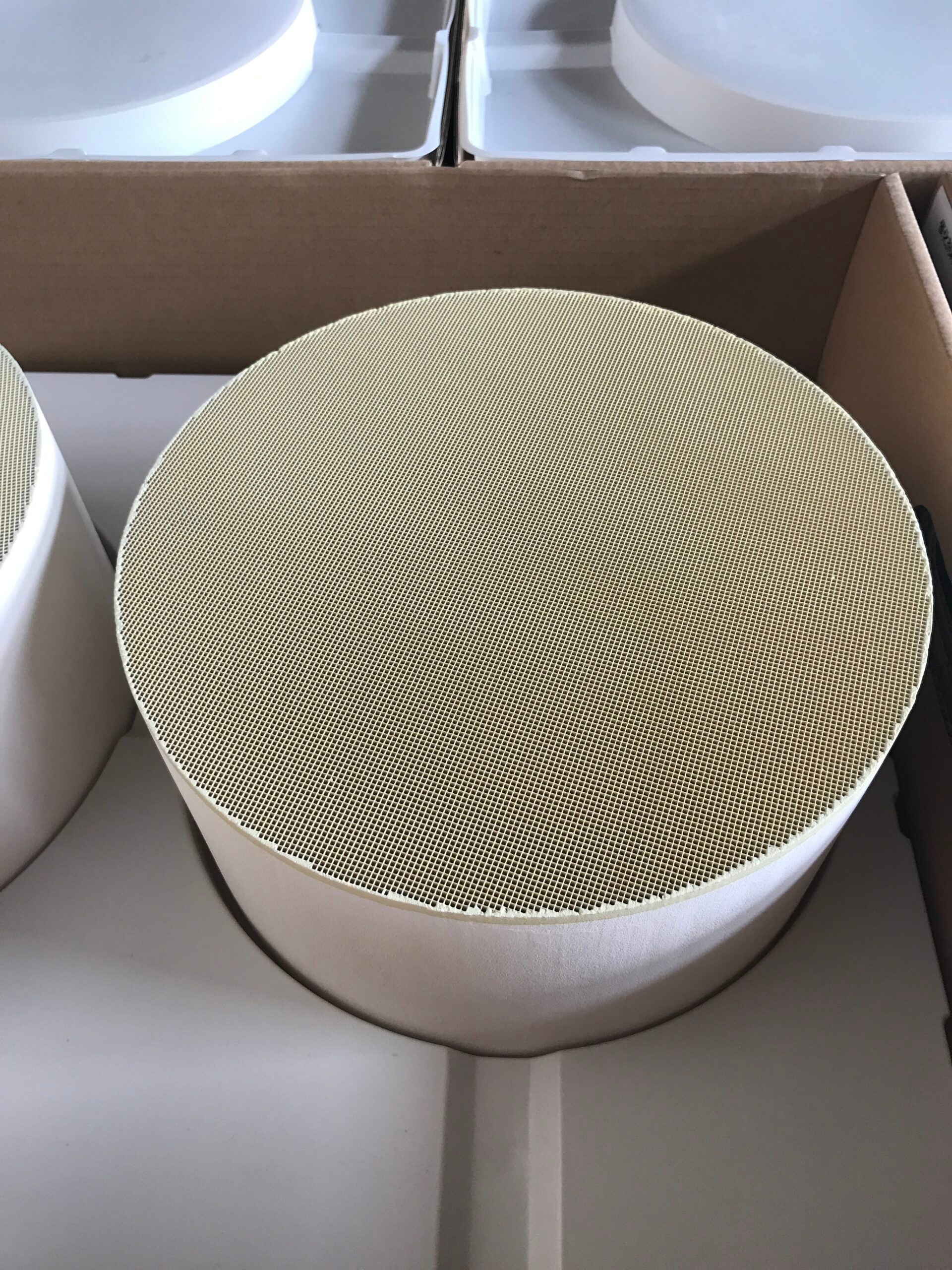
Our Hualian Catalyst SCR honeycombs give that chemistry a configurable flow path, with size and CPSI specified for the engine. We describe our catalyst through urea-SCR chemistry that converts diesel NOx into nitrogen and water.
The configurable substrate provides a physical route for exhaust to contact the active layer; it does not remove the need to match chemistry and dosing to the engine. Size, cell density, and installation position affect flow and contact conditions in which the reactions above take place.
For the selective catalytic reduction catalyst to serve a real application, the engineering file needs the exhaust-flow and temperature range, NO/NO₂ mixture, available space, and reductant strategy.
Changing CPSI may alter channel geometry and pressure loss, while changing size may alter residence and packaging. Neither variable can replace a suitable active formulation. Flow and residence effects from a geometry change are evaluated against a stated gas mixture and reductant strategy.
Our ability to customize the honeycomb is useful after those constraints are known. We can discuss geometry and CPSI against the customer’s engine data, while the reaction equations establish what the chemistry must accomplish.
The outcome still needs testing under a defined duty cycle; a balanced equation is a description of possible reactants and products, not proof of installed conversion.
Diesel SCR brings a chemical reaction and a physical flow path together. Ammonia supply and the NO/NO₂ composition determine the reaction opportunity; the honeycomb determines how the moving gas reaches the active surface. A useful design makes both sides explicit before a NOx-conversion claim is attached to the engine.